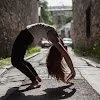
Standing Between Light & Dark
"To know oneself, one should affirm oneself, accept oneself, and express oneself. These are functions of the body." ~ Alexander Lowen
The Dance between our light, our gold and our shadow
There is a dance, a constant interplay between the conscious and the unconscious, between the polarities of being: ease and effort, light and dark. We move within these in-between spaces like a pendulum swinging back and forth. Guided by the limbic system, our emotional centre, we shift from one shape of life experience to another. Whether we are aware of this dance or not, it influences how we move through the world and, ultimately, how we engage with life. Our nervous system holds the imprints of both our joys and our wounds. The sympathetic nervous system can keep us stuck in cycles of reactivity, while the parasympathetic allows us to settle into our presence. From moment to moment, we are often driven by emotion but to see beyond it is to practise yoga. Yoga, when practised with awareness, becomes a bridge between these states, it offers us access to both our light and shadow in a way that allows us to integrate both. (Which is why your teacher always guides you back to your breath, back to sensation.)
Yoga offers us a way to witness this dance, a framework, much like modern psychology, that brings unconscious patterns to light. The polarities, biases, and fragments that shape our lives become visible within this framework, offering us the opportunity to see ourselves as we truly are. But do we want to? Are we ready to peel back the layers of our ego-centred selves?
Shadows
Can we see the shadows within the shadow? And yes, there are even shadows within shadows! It is the darkness that haunts us, not the light. The light side of our nature is often joyful, we seek those moments, grasping at the pleasure they offer. And yet, so often, aren’t we left wanting?
Light has always been a part of our nature, it is universal, appearing across many religious and spiritual traditions. But for now, let’s talk about yoga. In the Bhagavad Gita, Krishna says, “I am the light in the sun and the moon.” The festival of Diwali represents the triumph of light over darkness.
In Anam Cara, John O’Donohue writes, “Once human beings began to search for meaning in life, light became one of the most powerful metaphors to express the eternity and depth of life.”
So, what about the shadows?
If light is the great metaphor for consciousness, awareness, and divinity, then what of the darkness? What lurks beneath the surface of our being, the parts of ourselves we’d rather not see?
Carl Jung speaks of the shadow self; the aspects of our psyche that remain hidden, repressed, or disowned. These shadows contain not only our fears but also the parts of ourselves we have placed into a box because they have been deemed unworthy, shameful, or too loud. But within that locked box lie unexpressed aspects, some of which, as Jung describes, are our gold. A great example of this is a child who, having been told that they were too sensitive, learned to suppress this sensitivity. Growing up into adulthood, this may manifest as a struggle to be vulnerable, as they view this as a great weakness. Yet, their deep sensitivity is also a gift, it fosters empathy, creativity, and connection to others. This is the gold that Jung talks about.
These are the creative parts of us that never had the chance to truly bear fruit: our curiosity, our desire to create, our desire to express ourselves without fear of being seen or shamed for our authenticity. And yet, buried even deeper still, are our traumas, our habits of avoidance, and the conditioned responses that, often unwittingly, have shaped our lives.
Yet, within this darkness lies a force that longs to be expressed, to be seen, to come to life.
Meeting the Shadow Through Yoga
Yoga offers us an invitation to meet our shadows. When we practise, we step into the role of the observer, known as Purusha in Samkhya tradition and as witness consciousness (Sakshi Bhava) in Advaita Vedanta. We witness, sometimes incrementally and sometimes all at once, all the things that have shaped us and we are invited to do so without judgement.
To this day, I am not sure if this process can unfold fully in a group yoga class, surrounded by others. Is it possible to create a space truly free of judgement? After twenty years of practice, I am not yet convinced. But I do not want to impose my biases on you. So, let’s continue…
The stillness of meditation, the challenge of asana, and the rhythm of breath can, under the right conditions, create a container for what we usually push away. A space where the urge to create and transform can finally unfold and bear fruit through our feeling body.
In The Tibetan Book of Living and Dying, Sogyal Rinpoche gives us the subtle reminder that what we run away from only holds us tighter. We can negate the shadow and yet be enslaved by it, and to be enslaved may alter the whole course of our life's journey. But when we approach it with curiosity, we initiate the process of integration bringing together those disconnected aspects of ourselves in a way that allows us to become whole.
Here, I'm using "whole" metaphorically, not as perfection or a state of 'completion,' but more as a deeper embracing of ourselves within our own minds, our life experiences, and how we can move through life unbridled.
A Dance, Not a Battle
This dance between light and shadow is not a battle but a relationship! one that we can, if we so choose, navigate with compassion and a kind heart, one that requires us to hold our own hand. To do anything else would be to harm ourselves, and in turn, through our frustration and misunderstanding of perception, we may harm others too. The Bhagavad Gita tells us that yoga is the path of self-realisation. And self-realisation is not just about transcendence.
What if transcendence requires embodiment? What if true understanding lies not in escaping the body but in fully inhabiting it?
Alexander Lowen says, “To know oneself, one should affirm oneself, accept oneself, and express oneself. These are functions of the body.”
Ahimsa is the principle of non-harming. Patanjali asks us to be kind not only to others but also to ourselves. What if our true learning is about holding both our light and our darkness, not as opposing forces, but as necessary aspects of being human? Can we embrace our shadow without condemning ourselves for its presence? And instead, look with curiosity, like a child playing hide and seek?
And here, I will quote Barbara Ann Brennan from her incredible, life-changing book Hands of Light: “We find the old dualism of God/Devil dissolving into a whole in which we find the Goddess/God within merging with the God/Goddess without. Anything evil is not the opposite of Goddess/God, but resistance to the God/Goddess force.”
So, where to go now? Let’s start here…
Yoga is more than a practice, it is a mirror.
So, today, can you step onto your mat and just move, and listen with all your senses?
Can you hear the call of your gold, the things you run from, that perhaps are tied up in your empathy for others, that vulnerability you fear?
Can you sit with it?
For example, in a yin yoga pose such as Dragon, what arises within you?
What makes you uncomfortable?
What would happen if you took a deep breath and decided to stay… decided that you can handle whatever arises?
You can notice it all.
You can breathe yourself into stillness without holding any part of yourself in place.
There is no one you need to hold for except yourself, and right now, you don’t need to hold at all.
Because you are safe.
Because you can trust yourself right now in this place, in this pose, with this breath.
The emotions you do feel, you can breathe through them, like the breeze rushing through the trees.
The tree doesn't hold onto the elements; it lets them pass through.
Can you let them pass through?
Are you okay with allowing that?
What parts of you say no?
Can you seek them out like a child playing hide and seek, and see with that same curiousness a child has, what is hidden from your direct view?
What can you do if you feel not okay?
What can you hold onto as your anchor point?
There is a still space within you.
Can you find it and let it hold you?
True yoga, true transformation is not about escaping our darkness, but learning to see within it, learning to sit within it, not to the point of self-sabotage or annihilation, but to the point where we find we can handle whatever arises, whatever comes up for us.
What do you think?
Write to me as I always reply and love to hear your thoughts and reflections: info@gemmaryan.co.uk
Much love,
Gem xox