Yin Yang Philosophy
Yoga has the potential to transform the body, mind and internal landscape of the person. Yet when we practice only one style of movement, particularly strong and dominant yang forms, imbalance often develops.
Most modern yoga practice is yang in nature. With a focus on building heat, strength and cardiovascular fitness, and there is nothing wrong with this. But it is only one side of a broader spectrum.
Yin yoga is a complement to these active practices, anything that increases blood flow, engages muscle and elevates our heart rates carries yang qualities. Yin, by contrast, is slower and works more directly with the denser tissues of the body, fascia, connective tissue, joint capsule, ligaments and bones. On its own, it is incomplete, just as yang is incomplete on its own. We require both stress and recovery, movement and stillness, being and becoming.
Our modern lifestyles often lead us to live primarily in a yang state of mind and environment, and we may struggle to devote our time to a quieter practice. Many students find the quiet of Yin more challenging than strong movement practices. And over time, this imbalance may show up as fatigue, irritability or burnout. In this sense, life itself introduces Yin when we resist rest for too long.
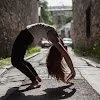
The principles of yin and yang are not abstract philosophical concepts, despite their appearance. They are observable all around us. Light reveals form, yet it also casts a shadow. Shadow conceals detail, yet depends entirely on light. Neither exists independently. Each contains the seed of the other, as illustrated by the Taijitu symbol (yin-yang symbol). There is no fixed dividing line between them, only a graduation and constant change.
Yin, when taken to excess, becomes stagnation; Yang, taken to excess, becomes depletion. The shift between them is continuous, much like our nervous system is never in one particular state for long; it shifts between the action of the sympathetic nervous system and the rest of the parasympathetic. Much like seasons turn, tides rise and fall, growth gives way to decay and returns again. We are not separate from this movement.
Different traditions describe this dynamic in different language. In classical yoga, we see Purusha and Prakriti, consciousness and manifestation. In Daoist thought we see Earth and Heaven, yin and yang. These are maps, but not absolutes. They offer a way of understanding our relationship with the world.
The Dao is often translated as the Middle Way. There is no fixed midpoint, but there is oscillation between opposites; it cannot be grasped or controlled, because it IS movement itself.
For us as teachers, we can apply these concepts in a very practical way. When a student leans toward effort and force, we can introduce steadiness and space. When stillness becomes disregulating, we can reintroduce movement and choice. Balance is not a static place; it is responsive to the moment.
Yin yoga provides a contained environment where we can see this dynamic directly. We are witnesses to sensations as they rise and fall, we notice resistance, impatience, the urge to keep striving and pushing through, and within that noticing there is space.
When both yin and yang are seen within practice, body and breath begin to coordinate naturally. The mind settles, as our need to react becomes seen, and a steadiness can often be found in that seen place. This is not about perfection or transcendence, but about fostering, or returning to, a more balanced relationship with ourselves as we notice the rhythms that already exist within us and around us.
Gem xox