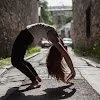
Why I Practice: Nervous System RegulatIon and Co-Regulation
The coffee arrives hard to the table, sugar dissolving, and my lips burn with that first zip. I bite the sore on my lip, listening to the throng of crowded tables, right-wing men vying for their views, talking over each other. Voices desperately loud. I sit in my own company, happy for the solitude and the sore lip to distract me, mainly from myself.
The hard bends of my practice life on the mat, the curiosity and wonder, this is what is on my mind today as I also consider my flight back north tomorrow. Mysticism drew me in and kept me on my mat for so long. I have been teaching whilst away, just a little. My mind returns again and again to why I practice. Picking up my coffee, I walk. Leaves crack beneath my sandals on my walk back to my sister’s, cracked dry earth whipped up by the dry breeze. It is hot in London, humid and far removed from the crackles I remember from just a week ago, submerging my head under cool Swiss mountain waters, the cackle of water rushing over pebbles settling me as I lay back, fully. My senses feel jarred here from noise. I do not think it is ever peaceful, and I end up turning in on myself to clear the cloud of foggy thoughts and lack of sleep. Drawing my senses closer to me, a sort of pratyahara practice, I listen inwards towards my own breath.
I am writing a course on the nervous system, but like most things for me, I have notes scribbled everywhere, not in one particular place, so I spend a lot of time hunting around in the hope that I will find them all. I’m curious about my own nervous system; the past few months I have needed cool water over pebbles, the weight of my own head letting go, a place quieter than my mind, so thoughts could retreat for a while. In nervous system language, this is called regulation. I know the meaning and the science behind getting into the parasympathetic state, but knowing the name of the state and experiencing it are two very different things.
Herman Hesse understood this in his own way. His mysticism was never a rigid or dogmatic system; it was not about a set of rules to follow, but a personal, experiential road walked inwards. He wrote;
‘Embark on the longer and wearier and harder road of life. You will have to multiply your two-fold being many times and complicate your complexities still further. Instead of narrowing your world and simplifying your soul, you will have to absorb more and more of the world and at last take all of it up in your painfully expanded soul, if you are ever to find peace.’ Herman Hesse
I read that in his book Steppenwolf, which you can find here, and I want to argue with it, because I have spent all week reaching for the simpler things: the quiet, solitude, and cool water. But I also think he is right that peace is not the same as quiet, and the road to it is longer than an hour on the table or yoga mat.
I have been teaching yoga for over 15 years now and doing massage for almost a decade. Recently, I have had an influx of people who are very well versed in nervous system language; they are fluent enough to describe their experience with astute elegance, and many of them know more about the nervous system than I do; and they are in it every day with their clients. And still they come, week after week, for the mat or the massage table and the hour for themselves. They come for something much like I was seeking in that cool water, a place outside of their very capable minds to settle themselves.
There is something reassuring and settling for the nervous system that can only be found in the presence of another settled person, when the weight of hands press onto tight shoulders and touch takes in the whole person, there can be no hurrying, this was always something I struggled with as a therapist in a clinical setting, the rush of it all, one client in on the table and then another and another, no thoughts or consideration for the bones, skin and person beneath our touch and our gaze because we had to keep time tight and worked on the owner’s clock. Even with the increase in AI, screen time, and apps that tell us our heart rate variability and readiness score, it will never be the same experience as another person really seeing us. That is something which cannot be downloaded.
The eyes catch it all, the hands feel it all, the feet touch the earth, and the body weights itself as it settles in. An app cannot see the held breath, the jaw held slightly, the small brace, that place when you can see in someone's eyes that they have left the building without moving. I can, because I am there; we are sharing the same breathing space, and I am paying attention. Half of my work is noticing the no that has not been said out loud, and adjusting gently before it needs to become a word at all.
This is also why, in yoga class or when working privately with a client, I do not always begin with the breath. For so many people, being told to notice the breath can itself create anxiety, fear and tension. Often, you signal the breath and the alarms go off internally: their chest tightens, they can't seem to get enough air, or it feels like it’s short. So I often begin lower down, finding feet and floor; perhaps if anxiety is present, it can help to draw their senses away from their internal experience and more toward noticing the light bouncing off the walls in the room, the chair sat in the corner, the colour of the chair, so that they can feel where they are before they inquire about what they are and their internal state. The breath may come later, or not at all.
Which door to open first is not in any yoga or massage manual; it is in the human experience of relating: noticing, observing, being present, holding space without naming it or interpreting what an experience may mean. It is in the hands, the eyes and the years.
I have noticed through those years that people who live by language often think around their own feelings. I see this a lot on social media when we talk about nervous system regulation: those who are fluent and well-versed can name their personal state and name it in others too, but that doesn't mean it's easy for them to stand inside it. I know this because I do it too. I did it this morning, biting my lip to stay out of my own head. I know I need the open spaces that home offers me in Scotland, that the water gives me that place to rest my head for a while, that what I can and do offer, sometimes is not another word but instead a hand resting on tired shoulders and a long quiet of a room that does not need words to fill it, this is the space my clients come for, a space to loosen the grip of their own minds and thinking, for the person underneath all of that to be felt again.
So they keep coming, and I keep practising, and I think I know why I lie back in cold water for rest, and they lie down on my table or mat; it's to be met, to be seen, to be held by something outside our own eloquent minds for a while. To set the noise down and be the body touching earth, in a space that feels safe whilst another is holding.
If you want to learn more about the massage I offer in Aboyne and visit my practice place in Scotland, you can learn more here. My nervous system training, Maps of Experience, runs live online from March 2027.
If slow, nervous system aware practice is what you are after, please sign up for my ad-free live classes here: Resources