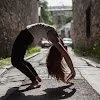
If the Asana is Gone Part 2
The breath, a verse from Samkhya and the seat of the Self
Its Saturday afternoon as I write this. This morning I was up early; I had been holed up in my bed since Wednesday with some sort of seasonal change flu. It was meant to rain all day, but the sun came out instead, and the wind picked up. I have such a lot of gardening to do, so much to cut back in the hope it returns next year, but I found myself walking into my conservatory, and it felt so warm that I got my mat out and did my Ashtanga practice instead. It’s a new moon, and in Ashtanga tradition we rest on moon days, but this one is in Libra, my sign, as is the sun right now, and today I have felt this surge and inspiration of energy. I love autumn and the unpredictability of the weather.
I have been reading the Samkhya Karika again, and there is one karika I turn to again and again. For some reason, when I hear the chant of it, or read the words, it inspires me, and that, coupled with the heady wind and sunshine and warmth of my little practice space…got me on my mat and second series and a little of third arrived.
Earlier this week, I wrote about the end of 2022, when my practice fell apart, or really when I fell apart, you can find that here. Some days all that was left was my breath, that one constant we meet whenever our attention falls away, or we feel overwhelmed, or even when we just want to connect to the part of us that is innate. As I said, it took me such a long time to really connect to my breath as my only practice for a while, and today, after almost four years to the day of my undoing and the slow return back to myself, my breath feels like a safe haven and a small part of me that actually holds me steady. So really it is not so small.
A verse I keep returning to…
There is a line I heard so many years ago; I think it was in a workshop with Harmony Slater, although I am not certain, and this is often attributed to Krishnamacharya: with each inhale we draw God close to us, and with each exhale we step a little closer to God. No matter who said it, or where I heard it, it soothes me, as does this karika from Samkhya philosophy; here is Srivatsa Ramaswami’s translation;
Karika 64:
evaṃ tattvābhyāsān nāsmi na me nāham ity apariśeṣam
aviparyayād viśuddhaṃ kevalam utpadyate jñānam
“Whatever I (my buddhi, my thinking faculty) have been thinking as the “I” is not the I anymore or ever was. This particular body belongs to prakriti, not to purusha. I am not this body, I am the Self, purusha. I am not this body, despite the feeling I have for this body (asmita), the feeling that I am this body. This body is not mine, it belongs to prakriti, not to purusha; I have no doubt about this.”
If I were to put this in the simplest terms, it is simply: I am more than what my body can or can’t do on any given day.
~ Srivatsa Ramaswami | Samkhya Karika: Translation and Commentary (2025), p. 176
If you’d like to read more, Ramaswami offers a gentle introduction to Samkhya philosophy. Gerand James Larson’s Classical Samkhya is the classic and is full of wisdom, but can be a little harder to read.
Patanjali in the second chapter of the Yoga Sutras, offers us these eight limbs or practices:
1) yamas: are often called ethical restraints, and put simply, they are really how we treat the world and those in it
2) niyamas: are our personal observances and are to do with personal care and growth;
3) asana: which is posture or seat,
4) pranayama: which is working with our breath;
5) pratyahara: is drawing our senses inwards (away from all those external distractions)
6) dharana: our focus and concentration,
7) dhyana :is meditation
8) samadhi: total absorption in all that is.
The yamas and niyamas come first. As I have said, the yamas show us how to treat the world around us:
~ ahimsa, non-harming;
~ satya, truthfulness;
~asteya, not stealing;
~ brahmacharya, moderation, the wise use of our energy;
~ aparigraha, not grasping.
In the yoga tradition, they are called the great vow or mahavratam (2.31), and they are universal and not exempt from one’s class, place, time, or circumstance.
The niyamas show us how to treat and care for ourselves:
~ saucha, cleanliness;
~ santosha, contentment;
~ tapas, discipline;
~ svadhyaya, self-study;
~ ishvara pranidhana, surrender to something larger than ourselves.
Without these first two limbs, there is nothing on which the others can hold; when we practice yoga without ahimsa or santosha, it just becomes another place to push ourselves too much or too far, to compare ourselves to others, to hold on and grasp for what we have achieved, holding so tightly even for what is no longer available to us.
I can say this because that’s where I was, holding tightly onto what no longer was.
Patanjali gives asana, the postures, a whole three sutras, three threads, out of 196! Sthira sukham asanam: the seat should be steady and at ease. The word asana means seat, but really Patanjali is talking about the seat of the Self, not about how deep the seat of your backbend is. When the seat of the Self is steady, then effort softens, and attention can rest on something larger, and the yogi, the student, the practitioner, is no longer knocked about by duality or opposites: hot and cold, praise and blame, ability or inability.
This is what I have always taught: that there is something deeper happening beneath the shapes we make on the mat, that the seat of our practice is the still point, and that when all about you are losing their minds, as Kipling almost put it, having found your seat, you can be steady.
When the seat goes:
But what happens when you lose the seat within yourself? When you lose your practice, your asana, when the mat is no longer there for you in the way that had held you steady for so long?
What we often don’t realise, especially with the way yoga is so often taught today, is how little time we give the rest of yoga practice. We arrive at class and set an intention, perhaps read a poem, and then we move on to asana, and the intention stays at the front of the mat, on the periphery of our asana. The breath, the attention, and perhaps the yamas and niyamas get a moment at the start and a moment at the end. So when the asana goes, there can be very little else we have practised enough to lean towards when it’s most needed.
The yoga sutras themselves sit on the foundation of Samkhya, which is one of the oldest schools of Indian philosophy. The name Samkhya actually translates as enumeration, so really it is a counting of everything that makes up our experience. The Samkhya karika begins with naming suffering, and there are three kinds:
Adhyatmika , suffering that arises within ourselves, in the body or the mind
Adhibbautika, is caused by other beings and other people. Adhidaivika, is caused by forces beyond our reach: the weather, accidents, what used to be put down to “acts of God”.
Ishvarakrisna, after describing the torments of each kind of suffering, tells us that the usual remedies, the ones we can see and the rituals we are told will work, help for only a little while and then wear off.
Back in 2022, and through most of 2023 and 2024, I was in a state of suffering, but it was not something outside myself. It was internal; years of pushing down what needed to surface. Looking at it face on and holding it steadily felt impossible. At the same time, I had stepped away from a studio I had founded. I had lost all sense of boundaries, and I would fall into a stupor of despair because I felt I had exposed myself to all the wrong people, and in some instances, I had. I simply did not feel like myself.
In Samkhya philosophy, suffering is the place we start from, and it asks what kind of knowing may change our relationship to it?
I want to write honestly, because this is what I am writing from, my experience. I had both. I had well over a decade of almost daily asana practice, and I had read the texts and taught some of them for years. Neither kept me from falling apart. Asana alone didn’t, and philosophy alone didn’t. They are tools, and a tool only helps when you can pick it up. For a long time I couldn’t pick up anything, and what came first was much smaller than what I had been used to; it was simply, as I have said, noticing my breath, and being a little kinder to myself than I had been, and slowly remembering that I was more than what my body could or couldn’t do on any given day. The tools came back into my hands very slowly, one at a time, and I am still learning to hold them more lightly than I once did.
I said in part one that I would conclude in part two, but this has taken on a life of its own. Writing it has drawn little mind maps for me, connections I don’t think I could see so clearly before I started. So next week I’ll finish. To be honest, it feels as though I am partly writing this for myself, to tie up the ends in my own head before the next stage of my practice and teaching unfolds.
As always, I hope this finds you holding yourself lightly and with care.
Warmly, Gem