
For qualified yoga teachers who want to understand stillness, functional teaching and responsible practice more deeply.
Yin Yoga Teacher Training
Functional anatomy, philosophy and the craft of teaching
50 hours · Live online · Tuesday evenings · 12 January to 9 March 2027.
A second cohort runs from 7 September to 2 November 2027.
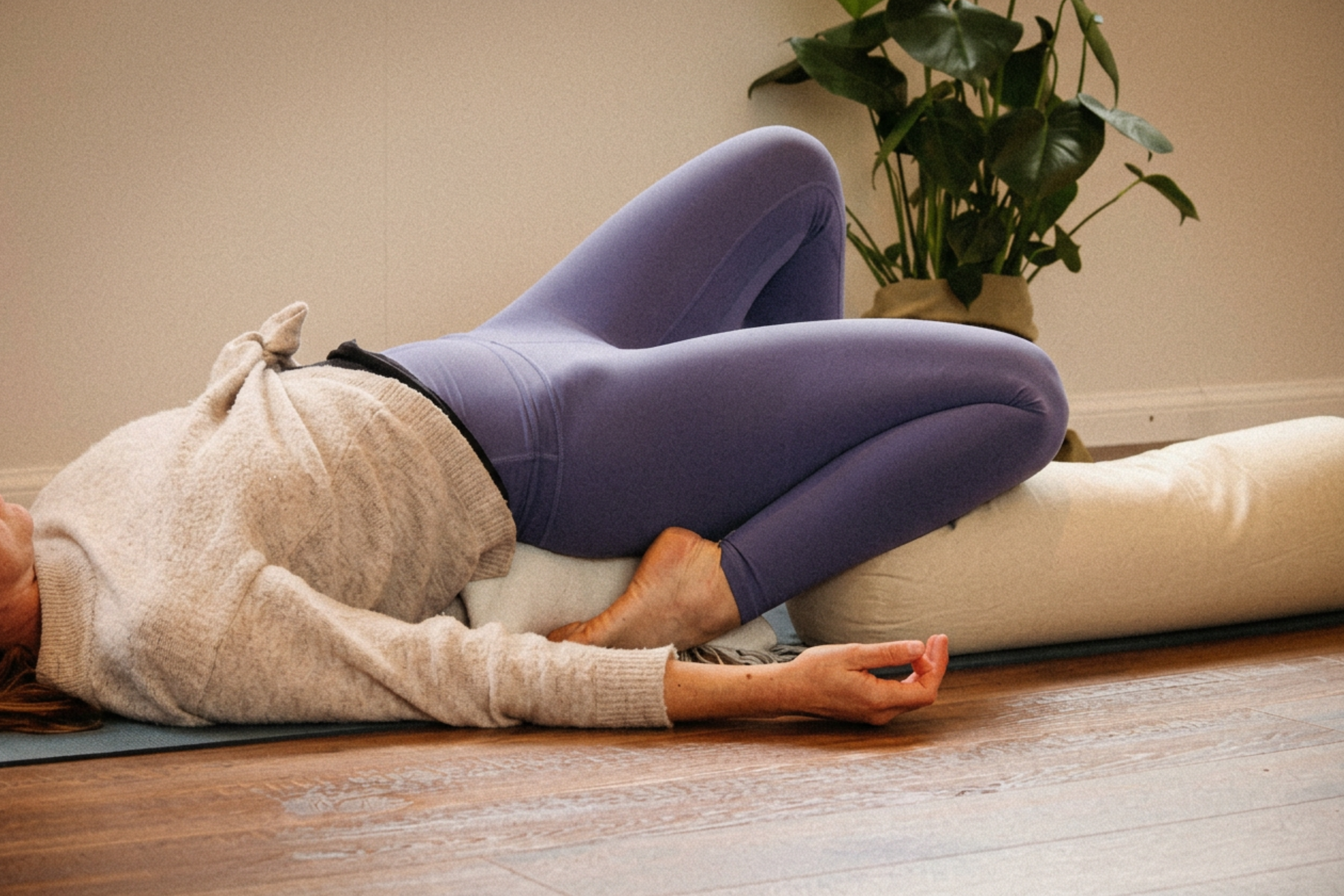
ABOUT THIS TRAININGFrom teaching shapes to teaching choices
I have taught Yin Yoga since 2012, and this training has changed steadily over time. When I first began offering Yin training in 2018, the emphasis was largely on the postures, sequencing and how to teach a balanced class. Those elements remain an important part of the curriculum. The focus has shifted from teaching shapes to cultivating discernment, restraint and professional responsibility in how Yin Yoga is taught and held.
Yin Yoga is presented here as a practice for general wellbeing, informed by functional anatomy, the philosophy of Samkhya and Patanjali’s Yoga Sutras, and nervous system education. It is not clinical or diagnostic.
STUDY
Learn a piece of anatomy, philosophy or physiology.
PRACTISE AND NOTICE
Explore it in your own body through long holds, breath and stillness. Notice what happens before deciding what it means.
RETURN
Bring your questions and teaching examples to share with the group.

This training is for you if
You are a qualified yoga teacher who wants to deepen your Yin teaching
You want a more mature, scope-aware approach to teaching
You are interested in anatomy, subtle body frameworks and professional ethics
You are a long-term practitioner with a consistent personal practice
You don’t need any previous Yin training
Four threads…

Philosophy
Samkhya and Patanjali’s Yoga Sutras: how they frame attention, stillness and practice. Yin and yang as the Daoist frame the practice grew from.
Functional anatomy
Joint structure, skeletal variation, muscle tone and connective tissue. Reading the body in front of you rather than an ideal shape.
Moving energy
Meridian theory and the Five Elements, with the koshas and chakras alongside Samkhya. Taught as philosophical and experiential maps, not medical models.
Teaching
Sequencing, invitational language, choice and consent, and staying within the scope of yoga teaching.
What you will study
This course is for teachers who are ready to move beyond formulaic Yin sequencing and into a more responsive way of teaching. You will learn how stillness, time, breath awareness and pacing shape the experience of practice, and how these place particular responsibility on the teacher. You are encouraged to observe carefully, use language with intention, and put choice and consent ahead of outcome.
It is less about adding more, and more about knowing what to offer, what to leave out, and how to hold a class steadily.
Key areas you will learn
-
The principles of Yin and how stillness, breath awareness and pacing shape the experience of practice. The philosophy that runs through the training comes from Samkhya and Patanjali’s Yoga Sutras, with yin and yang as the Daoist frame the practice grew from.
-
Anatomy sits at the centre of this training. How joint structure, skeletal patterning, muscle tone and connective tissue affect how a Yin posture is experienced. Rather than ideal alignment, you learn to read the body in front of you. Anatomy is a tool for observation and decision making, not diagnosis.
-
The core Yin shapes, what each one targets, how props change them, and how to offer variations that suit the person in the room.
-
Meridian theory and the Five Elements: the meridian lines, which poses work along which lines, and how the elements can shape a sequence and its intention. Taught as philosophical and experiential maps, not medical models.
-
What research can and can’t tell us about long holds and rest, and how breath awareness supports the practice. Polyvagal theory is taught as a working map, not settled fact.
-
Building a class, using invitational language, offering choice, and staying within the scope of yoga teaching. In the final session you teach, observe and give feedback, so you leave having practised the choices, not only read about them.
Dates & Format
12 January to 9 March 2027
Tuesdays, 18:30 to 21:00 UK
live online (Zoom)
The 50 hours include 20.5 hours taught live with me, 10 hours of recorded lectures, 9.5 hours of asana breakdowns and practice videos, and 10 hours of home study and integration between sessions.
8 live teaching sessions (2.5 hours each, 3 hours on 9 March)
Every live session is recorded and uploaded within 24 hours

Workbooks, recorded lectures and practice videos

50-hour certificate counts towards Yoga Alliance Continuing Education (YACEP)
Session schedule:
Tuesday 12 January: Foundations and philosophy, Samkhya and Patanjali
Tuesday 19 January: Functional anatomy
Tuesday 26 January: Skeletal variation and individual bodies
Tuesday 2 February: Integration week, no live session
Tuesday 9 February: Poses, variation and adaptation
Tuesday 16 February: Anatomy of moving energy, meridian theory and the Five Elements
Tuesday 23 February: Physiology, breath and stillness
Tuesday 2 March: Sequencing, language and teaching
Tuesday 9 March: Teaching Lab and closing (18:30 to 21:30)
Meet your teacher
I’m Gem. I’ve practised for over twenty years, have taught since 2011 and have taught Yin since 2012. I began training Yin teachers in 2018 and have trained more than seventy teachers to date. I’m completing an 875-hour yoga therapy diploma, and that study has shaped how I teach this training, with more attention to discernment, restraint, and the choices a teacher makes in the room.

From teachers who trained with me
“It showed me how to offer possibilities rather than instruction, and how valuable it is to create space for observation. Less really is more.”
Bela, February 2026 Yin Yoga Trainee
“It wasn’t just about learning how to teach Yin Yoga. It changed how I approach both my practice and teaching. I feel more grounded and more confident in how I hold space.”
Nicola, Health & Wellness Coach (February 2026 Yin Yoga Trainee)
Questions
Do I need previous Yin training?
No. The training is for qualified yoga teachers, and no previous Yin training is needed.
Do I need to attend every session live?
Live attendance is best, because the sessions are where the discussion and teaching practice happen. Every session is recorded, and you can catch up on anything you miss before the next week.
How long do I have access to the materials?
For the length of the course and one year after it ends, until 9 March 2028.
Can I pay in instalments?
Yes. The full price of £495 can be paid in three monthly payments of £165. The early bird price is paid in full.
Will I receive a certificate?
Yes. On completing the training and assessment you receive a 50-hour Yin Yoga Teacher Training certificate from Gem Maryan, E-RYT 500, YACEP. The hours count towards Yoga Alliance Continuing Education.
What if I need to cancel?
You have a 14-day cooling-off period from the date of booking. After that, bookings are non-refundable. If you can no longer attend, you may be able to transfer to the September 2027 training. Please get in touch to discuss.
Is there another date?
A second cohort runs from 7 September to 2 November 2027.
What if I’m not sure it’s right for me?
Email me at info@gemmaryan.co.uk and we can have a wee chat about whether it fits where you are in your teaching.
Price
£495, or three monthly payments of £165. Your certificate is issued once the final payment is received. The payment plan is available at the full price only.
Early bird: £395 if you book by 12 December 2026. The early bird is paid in full.
Your place includes all live sessions, recordings, course materials and workbooks, and one year of access to the recordings and materials after the course ends (until 9 March 2028).
12 places. Enrolment opens on 15 November 2026.